
Projector in Surat is becoming a popular choice as the way we consume visuals has undergone a massive transformation. While large-screen televisions have their place, nothing quite captures the immersive “wow factor” of a high-quality projector. Whether you are designing a dedicated home cinema, upgrading a corporate boardroom, or enhancing a classroom, a projector offers a scale and flexibility that fixed screens simply cannot match.
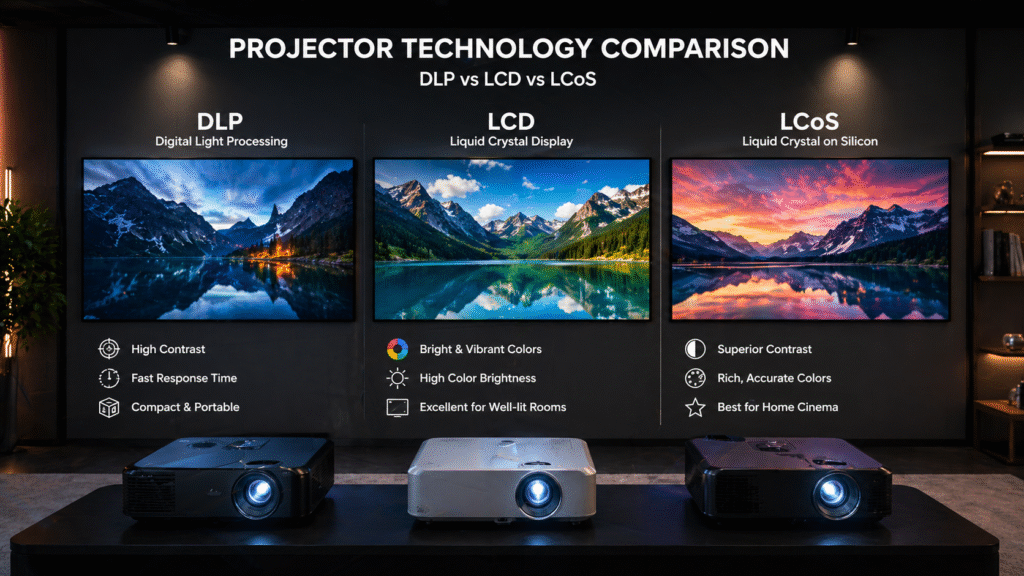
1. Understanding Projector Technology: DLP vs. LCD vs. LCoS
The first thing you will encounter when shopping for a projector is the underlying technology. Each has its own set of strengths. When selecting a projector in Surat, understanding DLP, LCD, and laser technology is important. When choosing a projector in Surat, understanding the latest technologies like DLP, LCD, and laser is important.
DLP (Digital Light Processing)
DLP projectors use tiny mirrors to reflect light. They are known for their sharpness and high contrast. Because the response time is incredibly fast, they are a favorite for action movies and gaming. They are also generally more compact, making them ideal for portable or ceilingmounted setups.
LCD (Liquid Crystal Display)
LCD technology is similar to what you find in many TVs. These projectors are praised for their vibrant color reproduction and brightness. They typically offer better “color light output,” meaning colors look just as bright as the white parts of the image.
LCoS (Liquid Crystal on Silicon)
LCoS is the “best of both worlds” technology often found in high-end home theaters. It provides the superior contrast and deep blacks of DLP with the rich, accurate colors of LCD. It is the gold standard for those seeking a true cinematic experience.
2. Light Sources: Lamp, LED, or Laser?
The light source determines how bright your projector is, how often you’ll need maintenance, and the overall cost of ownership. A high-quality projector in Surat with LED or laser light source ensures better performance and longer life.
- Traditional Lamps: These are the most affordable upfront. However, the bulbs have a limited lifespan (usually 3,000 to 5,000 hours) and dim over time.
- LED: LED projectors are energy-efficient and run much cooler. They last significantly longer—often up to 20,000 hours—and offer instant on/off capabilities.
- Laser: Laser is the future of projection. It offers the highest brightness, incredible color accuracy, and virtually zero maintenance for 20,000+ hours. While more expensive initially, the lack of bulb replacements makes them cost-effective in the long run for commercial and high-end residential use.
3. Brightness and Lumens: Seeing Through the Light
Brightness is measured in ANSI Lumens. Choosing the right brightness depends entirely on your environment. Choosing the right projector in Surat depends on your room size, brightness, and usage needs.
Dedicated Dark Rooms (Home Theaters): 1,500 to 2,500 lumens is usually perfect. In a dark room, too much brightness can actually cause eye strain.
- Multi-Purpose Rooms (Living Rooms): 3,000+ lumens are needed to compete with some ambient light from windows or lamps.
- Commercial/Boardrooms: 4,000 to 6,000+ lumens are standard here, as these rooms often have bright overhead lights and windows that cannot be fully covered.
4. Resolution: From Work Presentations to 4K Cinema
Resolution refers to the number of pixels used to create the image. The higher the resolution, the crisper the picture—especially when projected on a large scale. Learn more about LG projectors here.
- Full HD (1080p): The standard for most office presentations and entry-level home theaters. It provides excellent clarity for most viewers.
- 4K UHD: With four times the pixels of 1080p, 4K is essential for screens larger than 100 inches. It ensures that even when you are sitting close, you won’t see individual pixels.
- WUXGA: Often found in professional MAV installations, this is a slightly taller version of 1080p designed for laptops and data-heavy presentations.
5. The Throw Ratio: Long Throw vs. Short Throw
The “throw ratio” tells you how far back the projector needs to sit to create a specific screen size.
- Long Throw: These are standard projectors designed to be ceiling-mounted or placed on a back wall, making them ideal for large rooms and dedicated home theater setups.
- Short Throw: These can create a massive 100-inch image from just 3–5 feet away. They are perfect for small rooms or classrooms where people might walk in front of the light beam.
- Ultra-Short Throw (UST): These sit directly below the screen (often on a credenza) and can project a 120-inch image from just inches away. They are the modern alternative to a 100-inch TV.
6. The Screen: The Often Forgotten Hero
Many people make the mistake of projecting onto a plain white wall. While possible, a professional projector screen is designed with specialized coatings to:
- Increase Contrast: Making blacks look deeper and whites look brighter.
- Ambient Light Rejection (ALR): Special screens that reflect light coming from the projector while “absorbing” light coming from overhead or windows.
- Uniformity: Ensuring the image looks the same from every seat in the room.
7. Connectivity and Smart Features
Modern projectors are now smarter than ever. When choosing a model through MAV, look for:
- HDMI 2.1: For the latest gaming consoles and high-bitrate 4K content.
- Wireless Casting: Built-in Wi-Fi and Bluetooth allow you to stream directly from your phone or laptop without messy cables.
- Vertical & Horizontal Lens Shift: This allows you to move the image up, down, or sideways without moving the projector itself, making installation much easier.
8. Why Professional Installation Matters
A projector is only as good as its setup. Professional installation ensures:
- Perfect Calibration: Adjusting the color, focus, and keystone so the image is perfectly rectangular and life-like.
- Acoustic Integration: Aligning the visual with a professional sound system so the audio feels like it’s coming from the screen.
- Hidden Cabling: Ensuring a clean, professional look in your home or office.
Conclusion
The world of projectors is vast, but when you understand the core pillars—technology, brightness, and throw distance—you can find a solution that transforms your space. Whether you want to watch the big game on a 150-inch screen or give a high-stakes presentation that commands the room, MAV has the expertise to bring your vision to light. If you are planning to buy a projector in Surat, MAV offers the best solutions for every need.
Ready to upgrade your view? Contact our Website today for a personalized consultation on the latest projection technology.